A Reflection · Qur'an · Geology
The earth's silent pegs
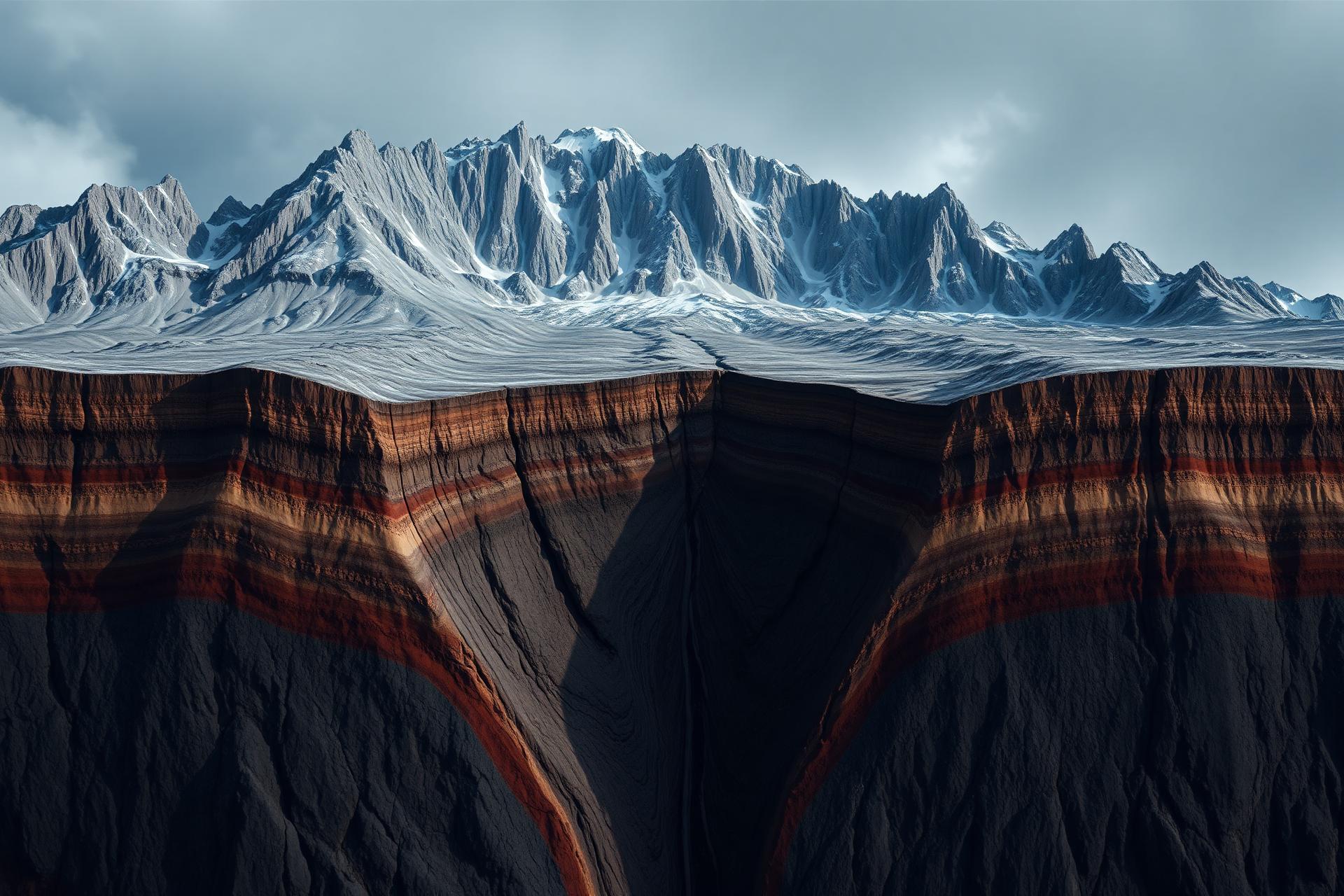
Mountains are not heaps of stone. They have roots — long, dense, plunging deep into the crust, balancing the surface above. A 7th-century Arabic word said it first.
Isostasy, 1855
Surveyors of the Himalayas found their plumb-lines pulled less than expected by the mountains — meaning beneath each peak lay a hidden, less-dense root descending into the mantle.
The principle, named isostasy, says continental crust floats on the denser mantle like an iceberg on water. The visible peak is a fraction of the mass. Most of the mountain — the part that holds it stable — is underground.
Who, on the surface, named the unseen?
Awtād — pegs
The mountains, He set as pegs.
An awtād — peg, stake, tent pin — is something most of which is buried, with a small head visible above. The Qur'an does not say boulders, summits, or piles. It chooses a word whose meaning depends on what is hidden. Geophysics calls this same hidden majority the crustal root.
01
Mount Everest height
8,849 m
02
Root depth ratio
~5–6×
03
Mountain root reach
down to 70 km
04
Plates on Earth
~15 major
05
Drift rate
2–10 cm/yr
06
Crust thickness
5–70 km
Stakes in the ground
We have not made the earth a resting place?
The verse opens with the earth as a cradle — and immediately balances it with mountains as pegs. Cradles and pegs share a logic: both are passive structures that stabilize what moves.
Plate tectonics, undiscovered until the 20th century, confirms that the crust does move. And mountain ranges sit precisely where plates have collided and locked.
أَلَمْ نَجْعَلِ ٱلْأَرْضَ مِهَـٰدًۭا وَٱلْجِبَالَ أَوْتَادًۭا
“Have We not made the earth a resting place, and the mountains as pegs?”
Lest it sway
Lest the earth shake with you.
The Arabic tamīd means to sway, to rock unstably. The verse says mountains were placed precisely so the earth does not tamīd with you.
Modern geophysics describes how mountain belts act as stabilizing weights, slowing the motion of plates and dampening surface deformation. The word and the science point at the same image.
وَأَلْقَىٰ فِى ٱلْأَرْضِ رَوَٰسِىَ أَن تَمِيدَ بِكُمْ
“And He has cast into the earth firm mountains, lest it shake with you.”
Moving like clouds
You think them firm, but they pass like clouds.
In a later verse, the Qur'an inverts the image: the mountains, which seemed solid, actually pass like clouds. For centuries this was read as a description of the Day of Judgment.
Today we measure continental drift directly with GPS: plates carrying entire mountain ranges drift several centimeters a year — the same speed your fingernails grow. The earth, quietly, is sailing.
وَتَرَى ٱلْجِبَالَ تَحْسَبُهَا جَامِدَةًۭ وَهِىَ تَمُرُّ مَرَّ ٱلسَّحَابِ
“And you see the mountains, thinking them rigid, while they pass like the passing of clouds.”
Reflection
The peaks are only the tip.
What is visible is the smaller half of every truth. The Qur'an names this everywhere — in mountains, in souls, in stars. Beneath each summit lies the part that holds.