A Reflection · Qur'an · Archaeology
The civilization before the flood
From Göbekli Tepe's 11,600-year-old pillars to whispered theories of a lost antediluvian people, the past is older than we thought. The Qur'an, too, names a city no one could build twice.
The whisper
Beneath Anatolian soil, archaeologists keep uncovering stone temples older than agriculture, older than pottery, older than the wheel.
Graham Hancock, Randall Carlson, and a growing chorus argue a sophisticated culture existed before a cataclysm — the Younger Dryas impact around 12,800 years ago — that erased coastal cities and reset humanity's memory. Mainstream scholars contest the details. The sites, however, are real.
What if memory itself was once larger?
Iram, the city of pillars
A city, the like of which was never built.
For centuries, scholars dismissed Iram as legend — until in 1992 a NASA-assisted satellite survey revealed buried desert trade routes converging at a place now identified with Ubar / Iram in southern Arabia. The Qur'an had named it 1,400 years earlier as a city of lofty pillars, the equal of which was never raised again.
01
Göbekli Tepe age
~9,600 BCE
02
Younger Dryas impact
~10,800 BCE
03
Sea level rise after
+120 m
04
Iram located
1992 · NASA SIR-C
05
Karahan Tepe pillars
~11,000 yrs
06
Submerged cities found
Dwarka · Yonaguni
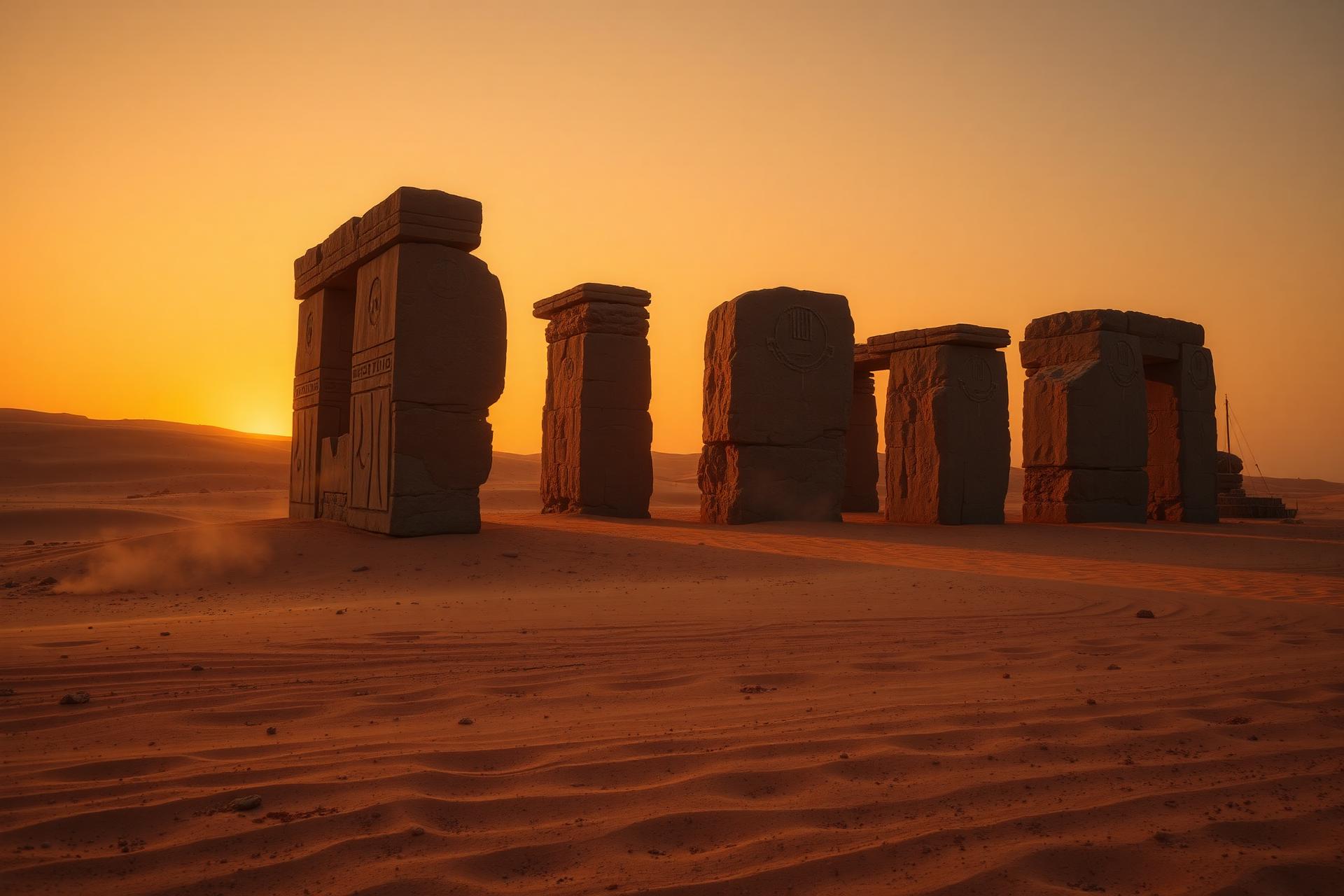
Pillars in the sand
Iram — of the lofty pillars.
The Qur'an describes the people of ʿĀd as masters of monumental architecture, raising pillars unmatched in their lands. Their excess, not their genius, brought their end.
In 1992, satellite radar revealed caravan routes converging on a buried city in Oman's Empty Quarter — what archaeologists now identify with Ubar, the lost city of pillars.
أَلَمْ تَرَ كَيْفَ فَعَلَ رَبُّكَ بِعَادٍ إِرَمَ ذَاتِ ٱلْعِمَادِ ٱلَّتِى لَمْ يُخْلَقْ مِثْلُهَا فِى ٱلْبِلَـٰدِ
“Have you not seen how your Lord dealt with ʿĀd — Iram, of the lofty pillars, the like of which was never built in any land?”
Stronger than us
They were mightier than you in power.
The Qur'an speaks repeatedly of nations who built more, dug deeper, and reshaped the earth more than the people being addressed. Until recently, this was read as rhetorical.
Now we know of stone monuments older than civilization itself, of submerged shorelines, of a young Holocene that began with a cataclysm. The past, it seems, was inhabited.
أَوَلَمْ يَسِيرُوا۟ فِى ٱلْأَرْضِ فَيَنظُرُوا۟ كَيْفَ كَانَ عَـٰقِبَةُ ٱلَّذِينَ مِن قَبْلِهِمْ ۚ كَانُوٓا۟ أَشَدَّ مِنْهُمْ قُوَّةً وَأَثَارُوا۟ ٱلْأَرْضَ وَعَمَرُوهَآ أَكْثَرَ مِمَّا عَمَرُوهَا
“Have they not travelled the earth and seen the end of those before them? They were mightier than them in strength and tilled the land and inhabited it more than they have.”
The ones We did not name
And others whose stories We have not told you.
The Qur'an explicitly says there were nations and messengers whose stories were never told. The named civilizations — ʿĀd, Thamūd, Madyan, the people of the well — are a few among many.
The verse leaves a door open. Behind it: pillars at Göbekli Tepe, ziggurats under sediment, a megalithic memory we are only beginning to recover.
وَرُسُلًۭا قَدْ قَصَصْنَـٰهُمْ عَلَيْكَ مِن قَبْلُ وَرُسُلًۭا لَّمْ نَقْصُصْهُمْ عَلَيْكَ
“And messengers We have already told you about, and messengers We have not told you about.”
Reflection
The dust holds witnesses.
Every shovel turns up another verse. The Qur'an does not need archaeology to be true; archaeology, it seems, keeps walking back to find it already there.